INSIGHTS → FINTECH
FINTECH
Money20/20 Middle East: Riyadh's Fintech Moment Is Becoming a Market Structure Story
The event brought banks, fintechs, regulators, investors and technology companies into the same conversation about the region's financial infrastructure.
Trust The Signal Editorial Team
Editorial Desk · SEP 17, 2026 · 3 MIN READ
Money20/20 Middle East took place at the Riyadh Exhibition and Convention Center in Malham from September 14 to 16, 2026. The organiser positions Money20/20 as a global platform for content, deal-making and networking across the money ecosystem.
Its Middle East edition brought banks, fintech companies, regulators, investors, startups and technology providers into the same venue. That mix offers a useful view of how financial technology is developing across the region, while the conclusions below remain editorial analysis rather than claims made by the organiser.
Fintech is converging with financial infrastructure
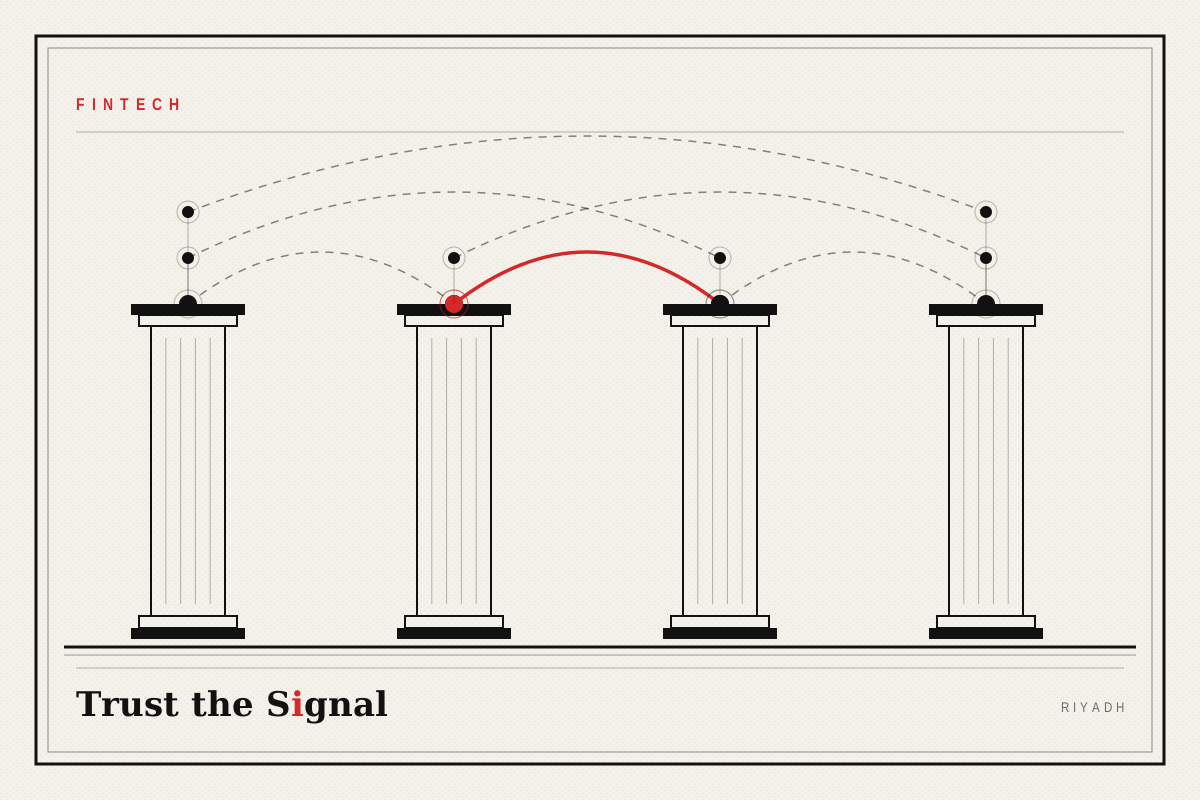
Our reading is that fintech is becoming less useful as a standalone category. Payments, banking infrastructure, embedded finance, digital identity, artificial intelligence and digital assets increasingly appear within the same strategic conversations.
This does not mean that these markets are technically or regulatorily identical. It means that institutions are evaluating them as connected parts of how financial products are built, distributed and governed.
The practical consequence is that a company can no longer be excellent at one layer and indifferent to the rest. A payments product that cannot evidence its identity controls is a compliance problem wearing a product's clothes.
Distribution matters as much as product
A strong product is only one part of scaling financial technology. Market access also depends on regulation, institutional partnerships, integration, customer acquisition and trust.
The strategic advantage may therefore belong to firms that can connect their technology with banks, merchants, investors and end users while meeting the requirements of the markets in which they operate. This is an interpretation of the market, not a reported outcome from the event.
Distribution is also where the margin tends to settle. Whoever holds the customer relationship generally sets the terms, which is why the interesting question about any bank-and-fintech partnership is not what it enables but who it leaves in front of the customer.
The strategic advantage may therefore belong to firms that can connect their technology with banks, merchants, investors and end users while meeting the requirements of the markets in which they operate.
What a conference floor cannot tell you
It is worth being explicit about the limits of this kind of evidence, because event coverage routinely overstates it.
Attendance measures interest, not revenue. A signed memorandum is a statement of intent with no delivery date attached. A product demonstrated on a stand has not been through a bank's security review. And the companies that chose not to exhibit are invisible in any account written from the floor.
That is not a reason to ignore the event. It is a reason to treat what was said there as a set of hypotheses to be checked against what ships over the following year.
Riyadh is strengthening its convening role
Hosting the Middle East edition places Riyadh on Money20/20's international event map and gives regional decision-makers a venue to meet global operators. The event itself demonstrates convening power. It does not, on its own, establish the size, maturity or future performance of Saudi Arabia's fintech market.
The more important question is what follows: partnerships executed, infrastructure deployed and products adopted within clear regulatory frameworks.
The signal
The Middle East fintech conversation is increasingly about market structure: who provides the infrastructure, who controls distribution, how regulation is applied and where trust is established.
For founders and financial institutions, the practical question is not only whether to enter the region. It is how to build durable access and credible partnerships once they are there.
That is a slower answer than a conference produces, and a more useful one.
What to watch
Open questions this piece does not answer. We will revisit them as evidence appears.
- 01Partnerships that reach production, as distinct from memoranda announced on stage.
- 02Whether licensing routes are clear enough for a foreign operator to plan against.
- 03Who ends up owning the customer relationship when a bank and a fintech distribute together.
- 04Whether regional infrastructure is built to interoperate across borders or stops at each national boundary.
SOURCES
Primary and official sources checked for this article. Everything beyond them is marked as our reading rather than reported fact.
- 1Money20/20 Middle East — Money20/20
ABOUT THE AUTHOR
Trust The Signal Editorial Team covers artificial intelligence, digital assets, capital markets, fintech and emerging technology, with a focus on real-world adoption, infrastructure and institutional change.