INSIGHTS → AI
AI
When AI Answers First, What Makes Your Brand Worth Visiting?
For U.S. businesses and publishers, AI search raises a commercial question that visibility alone cannot answer.
Silvia Mogas
Founder, Trust the Signal · OCT 3, 2026 · 6 MIN READ
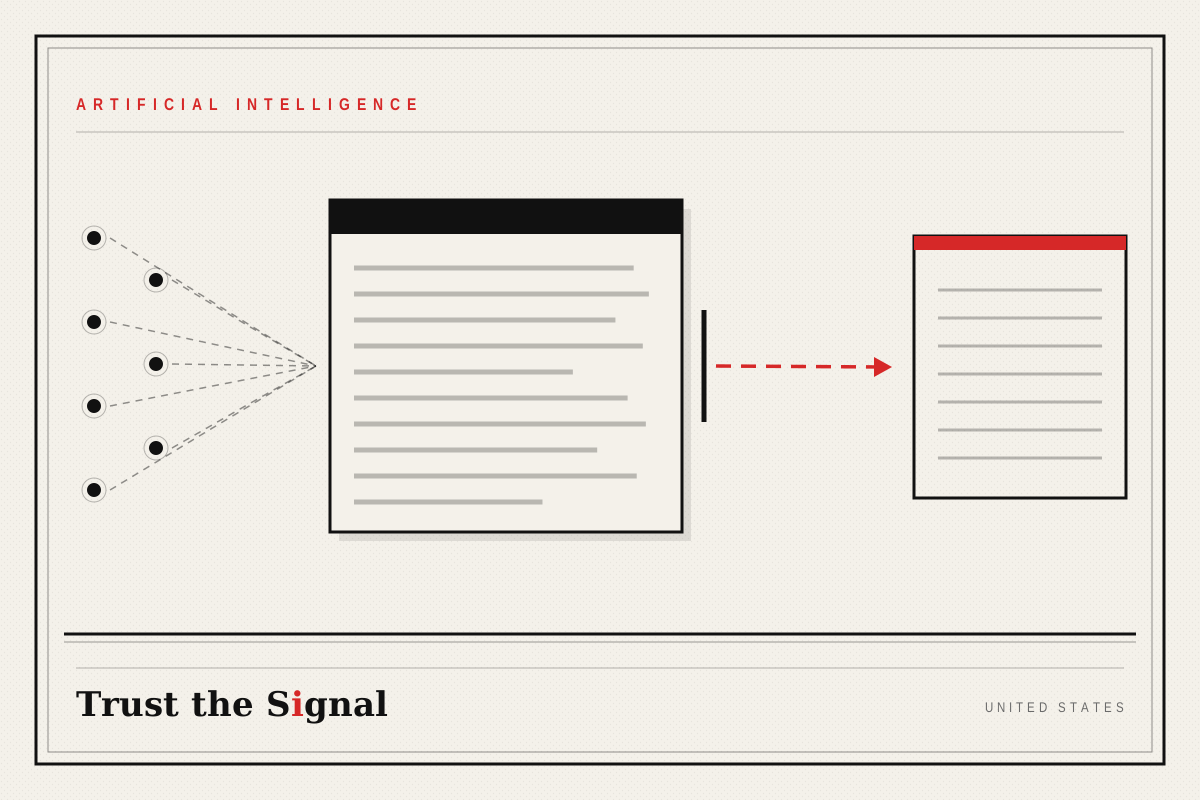
A customer can learn about your business without ever opening your website. They may read a summary, compare providers inside an AI interface and arrive at a decision with only fragments of the material you published.
That creates an uncomfortable question for anyone investing in content: what does success look like when your information is useful enough to inform an answer, but the reader has little reason to visit its source?
For American brands and independent publishers, I think this is becoming a question about the value of the destination itself. Being discoverable matters. So does having something worth discovering beyond the summary.
Being discoverable matters. So does having something worth discovering beyond the summary.
The evidence behind the concern
Pew Research Center analyzed browsing data from 900 U.S. adults, covering 68,879 unique Google searches in March 2025. Users clicked a traditional search result on 8% of visits to pages with an AI summary, compared with 15% on pages without one. Links inside the summaries received clicks on just 1% of visits to pages containing a summary. [1]
Those findings need careful framing. Pew reconstructed search results in April 2025, and the analysis was observational. It does not prove that the summary alone caused the difference, or that every business lost the same share of traffic. It is a historical snapshot of Google search behavior. [1]
A separate Pew survey conducted in February 2026 found that 60% of U.S. adults said they ever read AI summaries at the top of search results. Published in June, it provides more recent evidence of reach, but measures self-reported use rather than clicks. [2]
Together, these findings support a practical concern: an information strategy built around earning website visits needs to account for people receiving useful answers before they reach the website.
Getting cited is one outcome
An AI answer mentioning your brand, an answer citing your research and a customer visiting your site are different events. They deserve separate evaluation.
A citation may help someone discover your work. It does not tell you whether they understood the claim, remembered the source or considered buying anything. A brand mention may be accurate, incomplete or attached to an outdated description. Treating all of these as equivalent visibility can hide the detail that matters commercially.
Imagine a hypothetical U.S. software company publishing a guide to onboarding small-business customers. An AI system uses the guide to explain the process, and the user leaves with a helpful answer. That interaction could create familiarity with the company, but the citation itself gives no proof of a qualified lead.
The business still needs a reason for that reader to continue: a useful implementation template, a documented case study or a product that solves the problem the guide explains.
Be careful with the new optimization promises
Google's current guidance says special AI text files, including llms.txt, are unnecessary for visibility in Google Search. It also says there is no special schema markup required for generative AI search and no requirement to break content into tiny pieces. [3]
Its guidance emphasizes original, useful content and foundational search practices. Eligibility still matters: pages need to be indexed and eligible for snippets, and sites must be included in Search's generative AI features through the relevant Search Console control. [3]
This is guidance for Google, not a description of how every AI service selects sources. It does, however, give business owners a way to challenge claims that a special file or formatting technique will guarantee inclusion.
I would ask an agency proposing such work to explain the mechanism, identify the platform involved and define how results will be measured. A service becomes more credible when it can distinguish what the platform documents from what the agency is testing.
Give the reader something a summary cannot finish
My interpretation is that a stronger content strategy begins with material that helps someone make or carry out a decision. A short explanation may satisfy a simple question. A buyer facing a complex choice may need evidence, trade-offs and practical detail that deserve closer inspection.
For a U.S. B2B company, that might mean a case study describing the starting conditions, implementation costs and limitations. For a financial-services publisher, it could mean a sourced comparison that makes dates and assumptions visible. These are editorial suggestions, rather than guarantees of search performance.
The distinction also changes how authority is built. A company claiming expertise should make it easy to find who produced the work, what supports it and when it was last reviewed. Consistent descriptions of the business help readers understand whether the source is relevant to their question.
I think of this as making authority easier to inspect. Clear authorship and provenance allow a reader to assess a claim. They do not automatically make that claim true, and an AI citation does not remove the need to verify it.
Measure the relationship after the answer
For a content team, I would keep AI mentions and citations separate from site visits, newsletter subscriptions and qualified inquiries. Then I would look at whether the people who do arrive find something useful enough to continue the relationship.
Traffic remains valuable, but its commercial meaning depends on what happens next. A smaller audience reading a relevant case study may be more useful than a large audience leaving after a definition. That should be tested against actual outcomes, rather than assumed from engagement alone.
Trust the Signal has a role in that environment: publish work whose evidence remains visible and whose interpretation is worth reading in full. The ambition is to give readers a reason to return to the source when the answer matters to them.
For a brand considering its next content investment, I would start there. If an AI summary can answer the reader's entire question, what further value will they find when they arrive?
What to watch
Open questions this piece does not answer. We will revisit them as evidence appears.
- 01Whether an agency selling AI-optimization work can name the platform, explain the mechanism and define how results will be measured.
- 02Whether citations track anything commercial — inquiries, subscriptions, returning readers — rather than impressions alone.
- 03How AI services that publish no guidance of their own actually select and attribute sources.
- 04Whether the share of readers who continue past a summary moves as these interfaces change.
SOURCES
Primary and official sources checked for this article. Everything beyond them is marked as our reading rather than reported fact.
- 1Google Users Are Less Likely to Click on Links When an AI Summary Appears in the Results — Pew Research CenterPublished July 22, 2025. Browsing observations from March 2025; search results collected April 7–17, 2025. Observational, not a causal experiment.
- 2Americans and AI 2026: Chatbots, Smart Devices and Views on Impact — Pew Research CenterPublished June 17, 2026. Survey conducted February 17–23, 2026. Measures self-reported use.
- 3Optimizing Your Website for Generative AI Features on Google Search — Google Search CentralUpdated July 10, 2026. Platform-specific documentation for Google, checked October 3, 2026. It does not describe how other AI services select sources.
ABOUT THE AUTHOR
Silvia Mogas is the founder of Trust the Signal — an international speaker, strategist, lecturer and entrepreneur working across digital assets, capital markets and technology. Also founder of BMBWeb3 Ventures, with a background in tokenization and regulated digital assets. Her work takes her across New York, Dubai, Europe, Saudi Arabia and Asia.