INSIGHTS → RESEARCH
RESEARCH
America's AI Adoption Numbers Are Missing the Hardest Part
Buying access is easy. Proving that AI improves a business requires a much closer look at how work gets done.
Silvia Mogas
Founder, Trust the Signal · OCT 3, 2026 · 5 MIN READ
An executive can approve an AI subscription in an afternoon. Understanding whether that subscription improves the business takes longer, especially when the work involves several people, disconnected systems and decisions that still need human judgment.
This is where the conversation about AI adoption becomes interesting. A company may be using the technology every day while struggling to explain what has changed for its customers, its operating costs or the quality of its decisions. The usage is real. The business case remains a separate question.
For American companies deciding where to invest next, that distinction deserves more attention than another announcement about how many employees now have access to an assistant.
The usage is real. The business case remains a separate question.
What the adoption numbers actually measure
In a May 2026 analysis, the U.S. Census Bureau reported that business AI use ranged between 17% and 20% across survey periods from December 2025 to May 2026. In the period ending May 3, reported use was 33.9% in finance and insurance, compared with 19.8% nationally. These are dated observations, rather than a measure of adoption today. [1]
There is also a methodological detail worth understanding. In November 2025, the Census Bureau broadened its question from using AI to produce goods or services to using it in any business function. That makes the newer measure more inclusive, but complicates comparisons with the earlier series. [1]
A business drafting emails and a business redesigning its claims process can both report AI use. The statistic establishes that adoption exists. It does not establish the depth of integration or the return on investment.
My reading is that leaders need to treat adoption as the beginning of an investigation. The useful questions come afterward: Which work changed? Where did time disappear? Who now carries responsibility for checking the result?
Productivity depends on the work around the tool
There is credible evidence that AI assistance can improve performance. A study published in The Quarterly Journal of Economics examined 5,172 customer-support agents at a Fortune 500 business-software company. AI assistance increased issues resolved per hour by 15% on average, with larger gains among less experienced and lower-skill workers. [2]
The setting matters. The assistant supported a defined activity, and the researchers measured an operational outcome. This was evidence from one customer-support environment, not a promise that every department would receive the same improvement.
Other evidence makes the picture more nuanced. METR's July 2025 randomized study involved 16 experienced open-source developers completing 246 tasks in familiar repositories. With access to the AI tools studied, tasks took 19% longer. The result was explicitly limited to that setting and generation of tools. [3]
It would be misleading to carry that finding into 2026 without its update. In February 2026, METR said its follow-up experiment produced an unreliable estimate because of selection effects and measurement challenges. The researchers believed developers were likely benefiting more from newer tools, but could not reliably quantify the improvement from those data. [4]
These studies should encourage better measurement. A tool can help someone learn an unfamiliar process while adding review work for an expert. A faster draft can still leave the overall decision waiting in an approval queue.
Follow one customer request through the business
Consider an illustrative U.S. financial-services team introducing an assistant to answer customer questions. It generates a response quickly, but an employee still has to find the correct account information, verify the policy and obtain approval for an exception.
If the company measures drafting time alone, the pilot may look successful. If it measures the time until the customer receives a correct, usable answer, the improvement could be much smaller. The example is hypothetical, but it shows why the unit of measurement changes the conclusion.
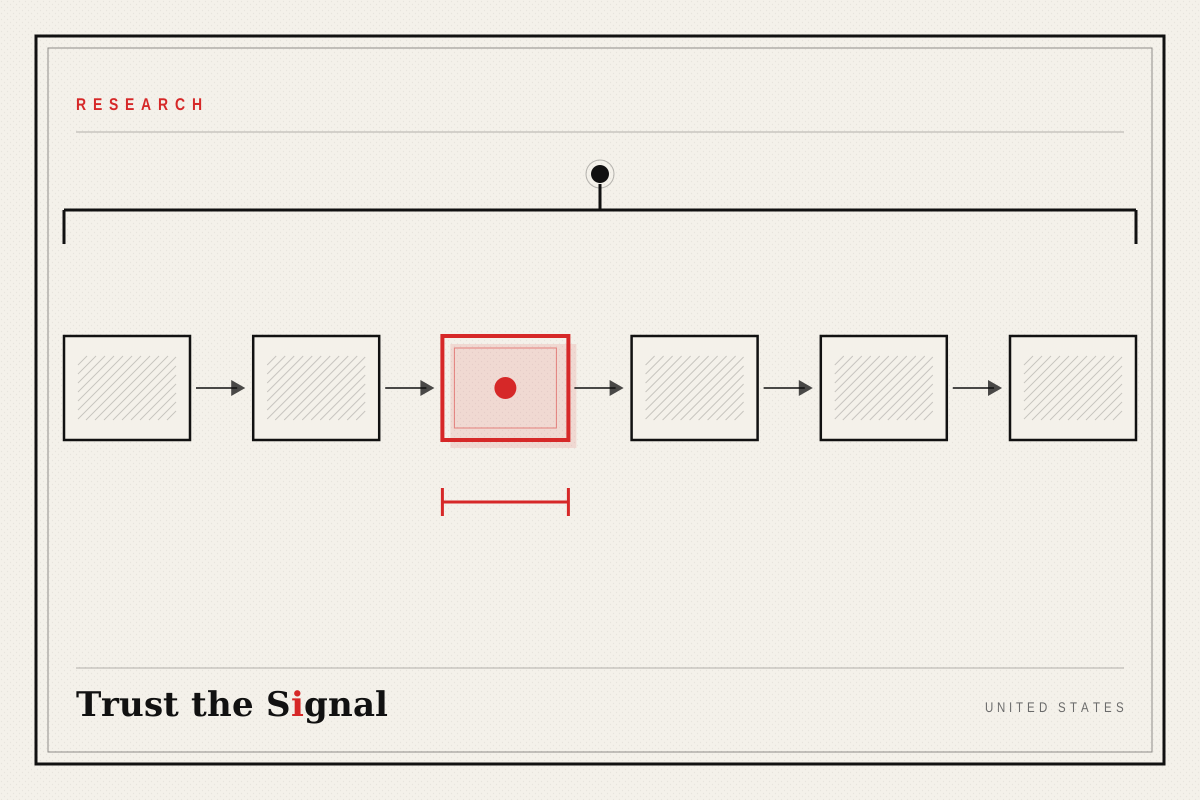
I would start with a recurring customer request and follow it from arrival to resolution. Record the time spent gathering information, preparing the response, checking it and correcting mistakes. Establish the current performance before introducing the assistant, then compare similar cases over a defined period.
That approach also makes costs easier to see. Subscription fees are only one part of the calculation. Staff review time, integration work and maintenance belong in the same assessment. Extra output has limited commercial value if nobody can use it without substantial correction.
Trust needs an operating role
For a pilot, I would ask the team to agree on what the assistant may do independently, which information it may use and which decisions need review. The person responsible for handling an exception should be clear before the exception arrives.
These choices make trust practical. An employee needs to know whether an answer comes from an approved policy or an unsupported inference. A customer needs a route to someone who can resolve the problem when the automated response is insufficient.
For U.S. founders and executives, the investment question is therefore specific: can the company make an important process more effective, at an acceptable total cost, while keeping responsibility clear?
An AI adoption announcement cannot answer that. A measured improvement in a customer's experience can. That is the evidence I would want on the table before expanding the budget.
What to watch
Open questions this piece does not answer. We will revisit them as evidence appears.
- 01Whether a pilot measures time to a correct, usable answer for the customer, or only drafting time.
- 02Where review work moves once drafting gets faster, and who absorbs it.
- 03Whether the cost side counts staff review, integration and maintenance alongside subscription fees.
- 04Whether METR's revised experiment design produces an estimate its own researchers consider reliable.
SOURCES
Primary and official sources checked for this article. Everything beyond them is marked as our reading rather than reported fact.
- 1Large Firms With at Least 20 Employees Biggest AI Users — U.S. Census BureauPublished May 26, 2026. Observations cover December 14, 2025–May 3, 2026. The survey question changed in November 2025, so the newer series is not directly comparable with the earlier one.
- 2Generative AI at Work — The Quarterly Journal of EconomicsPublished May 2025. Uses the published study's 15% result, rather than the earlier working paper's 14% estimate. Evidence from one customer-support environment.
- 3Measuring the Impact of Early-2025 AI on Experienced Open-Source Developer Productivity — METRPublished July 10, 2025. 16 developers, 246 tasks, familiar repositories. The researchers limited the result to that setting and generation of tools.
- 4We Are Changing Our Developer Productivity Experiment Design — METRPublished February 24, 2026. The follow-up produced an estimate METR judged unreliable; read alongside the July 2025 study rather than instead of it.
ABOUT THE AUTHOR
Silvia Mogas is the founder of Trust the Signal — an international speaker, strategist, lecturer and entrepreneur working across digital assets, capital markets and technology. Also founder of BMBWeb3 Ventures, with a background in tokenization and regulated digital assets. Her work takes her across New York, Dubai, Europe, Saudi Arabia and Asia.