INSIGHTS → ANALYSIS
ANALYSIS
Avalanche Summit New York: Blockchain Is Being Reframed as Business Infrastructure
The 2026 summit placed on-chain finance, institutional adoption and consumer applications at the centre of Avalanche's business narrative.
Trust The Signal Editorial Team
Editorial Desk · SEP 17, 2026 · 4 MIN READ
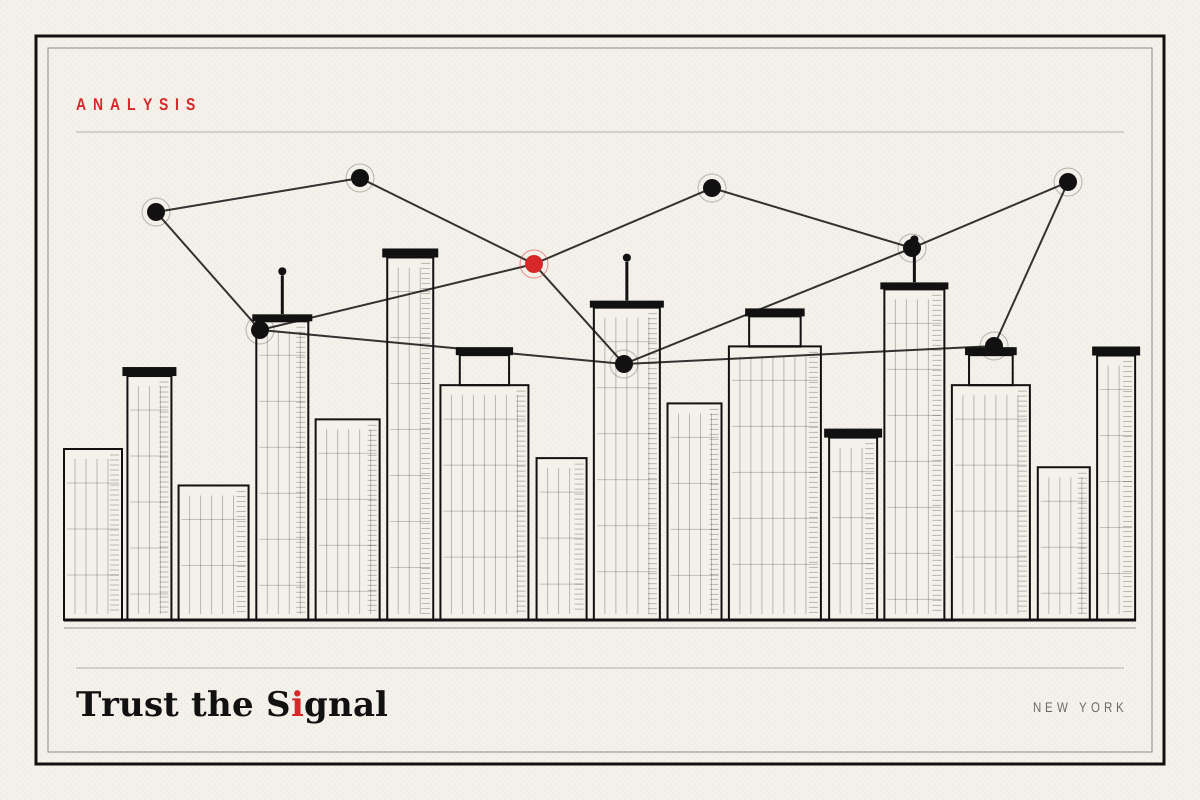
Avalanche Summit New York was held on September 16 and 17, 2026, at Chelsea Industrial in Manhattan. The official programme positioned the event around the future of business and finance, bringing together technology companies, financial institutions, investors and ecosystem builders.
The organiser highlighted two principal themes: on-chain finance and consumer applications. The agenda included keynotes, panels and fireside conversations on tokenized assets, blockchain-native liquidity, regulated capital markets, institutional adoption and digital consumer experiences.
What follows is our reading of that programme. It is editorial analysis, not a report of commitments made by any company present.
The language has shifted from possibility to application
Our reading is that the most relevant signal is not a single product announcement. It is the way blockchain is being presented. The emphasis has moved from explaining what the technology could become to showing where organisations may use it as infrastructure.
That framing places commercial outcomes, regulatory compatibility and operational control ahead of abstract ecosystem growth. It also raises the standard of proof. Enterprise adoption must be demonstrated through deployed systems and measurable use, not conference language alone.
The shift carries a cost for the industry telling the story. Infrastructure is judged by uptime, incident history and integration effort — unglamorous measures that take years to accumulate and cannot be accelerated by a keynote.
Enterprise adoption must be demonstrated through deployed systems and measurable use, not conference language alone.
On-chain finance requires more than speed
Avalanche presents performance, configurable networks and Ethereum compatibility as part of its institutional proposition. Those capabilities are relevant, but financial institutions also evaluate governance, identity, compliance, custody, interoperability and operational resilience.
The competitive question is therefore broader than which network processes transactions fastest. It is whether the infrastructure can fit into the legal, risk and distribution systems through which financial products already operate.
Throughput is also the easiest claim to make and the easiest to match. Where a benchmark can be equalled within a release cycle, it is unlikely to be the thing that decides a procurement committee.
What institutional adoption actually has to clear
A regulated institution moving a workload on-chain is not making a single decision. It is making a series of them, and each has an owner who can say no.
Custody has to be arranged with a qualified provider under terms the firm's risk function accepts. Identity and permissioning have to satisfy know-your-customer and sanctions obligations at the point of access, not after the fact. Settlement has to be final in a legal sense, not only a technical one, which usually means a lawyer has to be comfortable with what happens in an insolvency. Records have to reconcile with existing accounting and reporting systems. And there has to be a documented answer for what happens when something breaks at three in the morning.
None of this is an argument against the technology. It is a description of the surface area a platform has to cover before a large institution can use it at scale — and an explanation of why timelines in this market are measured in years.
The competitive set is wider than other blockchains
Public networks tend to be compared with one another. That understates the field.
The incumbent alternative is the market infrastructure that already exists and already works: central securities depositories, clearing houses, custodian banks and the messaging standards connecting them. These are not static. They can and do adopt parts of the same toolkit — private ledgers, tokenized representations, atomic settlement within a closed group of participants — without taking on the governance questions a public network brings.
So the honest framing is not blockchain against the status quo. It is a choice among several credible ways to get a similar outcome, in which openness is a genuine advantage for some use cases and a genuine liability for others.
New York is part of the message
Holding the summit in New York placed Avalanche's business narrative close to one of the world's most important capital-markets centres. Geography does not validate adoption, but it shapes the audience and the conversation.
The summit's focus on enterprises, institutions and investors suggests that the network wants to compete for real-world financial and consumer workloads, not only crypto-native activity. Choosing that audience means accepting that audience's standard of evidence.
The signal
Avalanche Summit New York reflected a wider market shift: blockchain platforms increasingly want to be judged as business infrastructure.
The winners will not be determined by technical claims alone. They will be determined by which platforms can connect performance with governance, compliance, distribution and applications that people and institutions actually use.
That is a higher bar than the industry set for itself in previous cycles. It is also the bar that comes with being taken seriously.
What to watch
Open questions this piece does not answer. We will revisit them as evidence appears.
- 01Named institutions running production workloads, rather than pilots described in the future tense.
- 02How identity, permissioning and compliance are handled at the protocol layer versus bolted on by intermediaries.
- 03Whether custody and settlement arrangements satisfy the firms that already hold the client relationships.
- 04Whether consumer applications retain users once incentives are withdrawn.
SOURCES
Primary and official sources checked for this article. Everything beyond them is marked as our reading rather than reported fact.
- 1Avalanche Summit New York — Avalanche Summit
- 2Avalanche official platform and event information — Avalanche
ABOUT THE AUTHOR
Trust The Signal Editorial Team covers artificial intelligence, digital assets, capital markets, fintech and emerging technology, with a focus on real-world adoption, infrastructure and institutional change.